Tuesday, 1 May 2012

Kuala Ketil @ Labour Day

Information

Kuala Ketil is a small town in Kedah, Malaysia. Kuala Ketil is situated within the parliamentary constituency of Baling. The town is located between Sungai Petani and Kulim.Kuala Ketil is the main source for Baling economy . Its main core business would best describe as Industrial area an up growing area. This small town play a role as the supplier for daily needs to the nearest estates around Kuala Ketil.
The boost of income for Kuala Ketil economy started on 1993 when the government developed the industries area. The area were named to this small town known as "Taman Perindustian Kuala Ketil".


Camera - Nikon
Model - D7000
Exposure - 1/160s
Aperture - F20
Focal Length - 105mm + Raynox DCR250
ISO Value - 100
Camera - Nikon
Model - D7000
Exposure - 1/160s
Aperture - F18
Focal Length - 105mm + Raynox DCR250
ISO Value - 100
Camera - Nikon
Model - D7000
Exposure - 1/160s
Aperture - F20
Focal Length - 105mm + Raynox DCR250
ISO Value - 100
Camera - Nikon
Model - D7000
Exposure - 1/160s
Aperture - F20
Focal Length - 105mm + Raynox DCR250
ISO Value - 100
Camera - Nikon
Model - D7000
Exposure - 1/160s
Aperture - F20
Focal Length - 105mm + Raynox DCR250
ISO Value - 100

Tuesday, 17 April 2012

Shadow Of Diamonds

Camera - Nikon
Model - D7000
Exposure - 0.8s
Aperture - F4
Focal Length - 44mm
ISO Value - 100

Camera - Nikon
Model - D7000
Exposure - 1/2s
Aperture - F2.8
Focal Length - 50mm
ISO Value - 100
Camera - Nikon
Model - D7000
Exposure - 35s
Aperture - F16
Focal Length - 35mm
ISO Value - 100

Friday, 13 April 2012

Playing With Lighting @ Putrajaya

Information

Putrajaya is a planned city, located 25km south of Kuala Lumpur, that serves as the federal administrative centre of Malaysia. The seat of government was shifted in 1999 from Kuala Lumpur to Putrajaya, due to the overcrowding and congestion in the Kuala Lumpur areas. Nevertheless, Kuala Lumpur remains Malaysia's national capital, being the seat of the King and Parliament, as well as the country's commercial and financial centre. Putrajaya was the brainchild of former Prime Minister Tun Dr Mahathir Mohammad. In 2001, Putrajaya became Malaysia's third Federal Territory after Kuala Lumpur and Labuan. More details, please visit this link http://en.wikipedia.org/wiki/Putrajaya

Camera - Canon
Model - EOS 550D

Exposure - 8s
Aperture - F16
Focal Length - 29mm
ISO Value -200

Camera - Canon
Model - EOS 550D

Exposure - 1/2s
Aperture - F8
Focal Length - 18mm
ISO Value -800

Monday, 9 April 2012

Jumping Spider In Action @ Sg. Meriam, Kota Kuala Muda

Information

Although Jumping spiders look peaceful, they are active hunters that stalk and pursue prey until close enough to attack. They select prey on the basis of experience and seemingly they have a preference for slow moving prey. Jumping spiders are poly-phagous meaning that they consume almost anything. Due to their complex eight eyes arranged in three rows, they possess an excellent vision, and where many spiders are nocturnal, Jumping spiders are diurnal.
Large Jumping Spiders such as Phidippus spp, which are found in North America, reach lengths of 8-15 mm. Jumpings spiders sometimes hunt in pairs, male and a female together, and during daytime. That relationship is sympatric meaning that it is mutually beneficial.
Their vision is important for catching the prey they pursue. According to several sources (Land 1969ab & Blest et al. 1990) the spatial accuracy of Jumping spider's eyes is approaching that of large mammals. More detail, please go to this link http://www.jumpingspider.net/

Camera - Nikon
Model - D7000
Exposure - 1/200s
Aperture - F22
Focal Length - 105mm + Raynox DCR250
ISO Value - 100
Camera - Nikon
Model - D7000
Exposure - 1/200s
Aperture - F22
Focal Length - 105mm + Raynox DCR250
ISO Value - 100
Camera - Nikon
Model - D7000
Exposure - 1/200s
Aperture - F22
Focal Length - 105mm + Raynox DCR250
ISO Value - 100

Sunday, 8 April 2012

Flies @ Sungai Meriam, Kuala Muda

Information

True flies are insects of the order Diptera (from the Greek di = two, and ptera = wings). They possess a pair of wings on the mesothorax and a pair of halteres, derived from the hind wings, on the metathorax. Apart from secondarily flightless insects (including some flies), the only other order of insects with any form of halteres are the Strepsiptera, and theirs are on the mesothorax, with the flight wings on the metathorax. For more details, please visit http://en.wikipedia.org/wiki/Fly


Camera - Nikon
Model - D7000
Exposure - 1/125s
Aperture - F25
Focal Length - 105mm + Raynox DCR250
ISO Value - 100
Camera - Nikon
Model - D7000
Exposure - 1/125s
Aperture - F25
Focal Length - 105mm + Raynox DCR250
ISO Value - 100
Camera - Nikon
Model - D7000
Exposure - 1/125s
Aperture - F25
Focal Length - 105mm + Raynox DCR250
ISO Value - 100
Camera - Nikon
Model - D7000
Exposure - 1/125s
Aperture - F25
Focal Length - 105mm + Raynox DCR250
ISO Value - 100
Camera - Nikon
Model - D7000
Exposure - 1/125s
Aperture - F25
Focal Length - 105mm + Raynox DCR250
ISO Value - 100
Camera - Nikon
Model - D7000
Exposure - 1/125s
Aperture - F25
Focal Length - 105mm + Raynox DCR250
ISO Value - 100


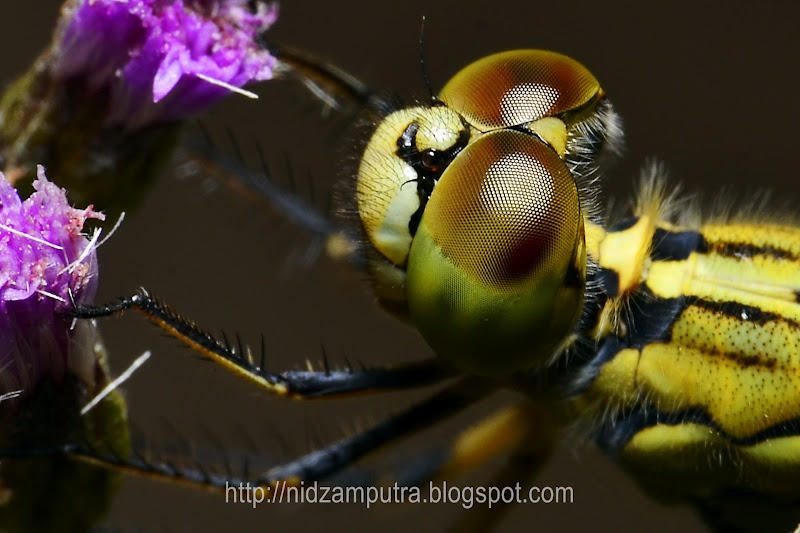
Dragon Hunter @ Kota Kuala Muda, Kedah

Information

A dragonfly is a winged insect belonging to the order Odonata, the suborder Epiprocta or, in the strict sense, the infraorder Anisoptera (from Greek ανισος anisos, "uneven" + πτερος pteros, "wings", due the hindwing being broader than the forewing). It is characterized by large multifaceted eyes, two pairs of strong transparent wings, and an elongated body. Dragonflies are similar to damselflies, but the adults can be differentiated by the fact that the wings of most dragonflies are held away from, and perpendicular to, the body when at rest. Dragonflies possess six legs (like any other insect), but most of them cannot walk well. Dragonflies are some of the fastest insects in the world.
Dragonflies are valuable predators that eat mosquitoes, and other small insects like flies, bees, ants, wasps, and very rarely butterflies. They are usually found around marshes, lakes, ponds, streams, and wetlands because their larvae, known as "nymphs", are aquatic. Some 5680 different species of dragonflies are known in the world today. For more details, please visit http://en.wikipedia.org/wiki/Dragonfly

Camera - Nikon
Model - D7000
Exposure - 1/200s
Aperture - F22
Focal Length - 105mm + Raynox DCR250
ISO Value - 100
Camera - Nikon
Model - D7000
Exposure - 1/200s
Aperture - F22
Focal Length - 105mm + Raynox DCR250
ISO Value - 100
Camera - Nikon
Model - D7000
Exposure - 1/200s
Aperture - F22
Focal Length - 105mm + Raynox DCR250
ISO Value - 100
Camera - Nikon
Model - D7000
Exposure - 1/200s
Aperture - F22
Focal Length - 105mm + Raynox DCR250
ISO Value - 100
Camera - Nikon
Model - D7000
Exposure - 1/200s
Aperture - F22
Focal Length - 105mm + Raynox DCR250
ISO Value - 100
Camera - Nikon
Model - D7000
Exposure - 1/200s
Aperture - F22
Focal Length - 105mm + Raynox DCR250
ISO Value - 100
Camera - Nikon
Model - D7000
Exposure - 1/200s
Aperture - F22
Focal Length - 105mm + Raynox DCR250
ISO Value - 100
Camera - Nikon
Model - D7000
Exposure - 1/200s
Aperture - F22
Focal Length - 105mm + Raynox DCR250
ISO Value - 100
Camera - Nikon
Model - D7000
Exposure - 1/200s
Aperture - F22
Focal Length - 105mm + Raynox DCR250
ISO Value - 100

Saturday, 31 March 2012

Jumping Spider The Series @ Sg. Meriam

Info

The jumping spider family (Salticidae) contains more than 500 described genera and about 5,000 described species, making it the largest family of spiders with about 13% of all species. Jumping spiders have some of the best vision among invertebrates and use it in courtship, hunting, and navigation. Though they normally move quietly and fairly slowly, most species are capable of very agile jumps, notably when hunting, but sometimes in response to sudden threats. Both their book lungs and the tracheal system are well-developed, and they use both systems (bimodal breathing). Jumping spiders are generally recognized by their eye pattern. All jumping spiders have four pairs of eyes with very large anterior median eyes. More detail please go through this link http://en.wikipedia.org/wiki/Jumping_spider

Camera - Nikon
Model - D7000
Exposure - 1/160s
Aperture - F20
Focal Length - 105mm + Raynox DCR250
ISO Value - 100
Camera - Nikon
Model - D7000
Exposure - 1/160s
Aperture - F20
Focal Length - 105mm + Raynox DCR250
ISO Value - 100
Camera - Nikon
Model - D7000
Exposure - 1/160s
Aperture - F20
Focal Length - 105mm + Raynox DCR250
ISO Value - 100
Camera - Nikon
Model - D7000
Exposure - 1/160s
Aperture - F20
Focal Length - 105mm + Raynox DCR250
ISO Value - 100
Camera - Nikon
Model - D7000
Exposure - 1/160s
Aperture - F20
Focal Length - 105mm + Raynox DCR250
ISO Value - 100


Bermacro Sejenak @ Sungai Meriam, Kota Kuala Muda Bahagian 2

Camera - Nikon
Model - D7000
Exposure - 1/160s
Aperture - F22
Focal Length - 105mm + Raynox DCR250
ISO Value - 100
Camera - Nikon
Model - D7000
Exposure - 1/160s
Aperture - F20
Focal Length - 105mm + Raynox DCR250
ISO Value - 100
Camera - Nikon
Model - D7000
Exposure - 1/160s
Aperture - F22
Focal Length - 105mm + Raynox DCR250
ISO Value - 100

Camera - Nikon
Model - D7000
Exposure - 1/160s
Aperture - F20
Focal Length - 105mm + Raynox DCR250
ISO Value - 100


Mentari Melabuhkan Tirainya Di Sungai Meriam Kota Kuala Muda

Camera - Casio
Model - EX-Z1080
Exposure - 1/250s
Aperture - F4
Focal Length - 38mm
ISO Value - 80

Thursday, 29 March 2012

Bermacro Sejenak @ Sungai Meriam, Kota Kuala Muda

Camera - Nikon
Model - D7000
Exposure - 1/160s
Aperture - F16
Focal Length - 105mm + Raynox DCR250
ISO Value - 100
Camera - Nikon
Model - D7000
Exposure - 1/160s
Aperture - F16
Focal Length - 105mm + Raynox DCR250
ISO Value - 100
Camera - Nikon
Model - D7000
Exposure - 1/160s
Aperture - F16
Focal Length - 105mm + Raynox DCR250
ISO Value - 100
Camera - Nikon
Model - D7000
Exposure - 1/160s
Aperture - F16
Focal Length - 105mm + Raynox DCR250
ISO Value - 100